
Supercompensation describes the principle whereby, after the stress caused by training and appropriate recovery, the organism can adapt and be better prepared to subsequently face a similar stimulus. But this idea should not be interpreted as an exact clock or a single process that always occurs in four perfectly defined phases.
Performance depends on multiple adaptations that recover at different speeds. Glycogen, neuromuscular function, muscle tissue, or the perception of fatigue do not necessarily follow the same schedule.
That is why training more does not automatically mean improving more. To progress, you need to combine stimulus, recovery, nutrition, and proper planning of subsequent sessions.
What is sports supercompensation and why do most athletes ignore it
Sports supercompensation is a model used to explain how the body responds to a training load. First, fatigue appears, then recovery takes place, and, with proper programming of new stimuli, adaptations occur that allow for improved performance.
The key lies precisely in adaptation. Training provides the stimulus, but a good part of the recovery and remodeling processes occur after finishing the session.
This explains why stringing together demanding workouts without sufficient recovery is not necessarily better. To improve, you need to apply an appropriate load and then have enough energy, nutrients, and rest to assimilate it.
It is also advisable to avoid a common simplification: there is no universal moment in which the entire organism simultaneously reaches a supposed "supercompensation peak." Each physiological process has its own kinetics of recovery and adaptation.
The supercompensation cycle: the 4 phases that occur after every workout
The supercompensation cycle is usually represented by four phases: stimulus, fatigue, recovery-supercompensation, and involution. It is a useful model for understanding the basic logic of training, but it should not be interpreted as an identical physiological curve for all athletes.
The magnitude and duration of each phase depend on the session performed, the athlete's experience, their nutritional status, sleep, stress, and the proximity of other sessions.
Phase 1. Stimulus: the stress that activates adaptation
Everything starts with a sufficiently relevant training load. A long run, an interval session, or several hours of cycling temporarily alter homeostasis and generate a physiological demand to which the body will have to respond.
Depending on the session, a reduction in glycogen stores, neuromuscular fatigue, metabolic stress, and transient alterations in different physiological systems may occur.
The stimulus, therefore, is necessary. But accumulating ever-increasing stimuli without providing sufficient recovery does not guarantee superior adaptation.
Phase 2. Fatigue: the body below its initial level
Immediately after a demanding session, it is common for the ability to repeat that same effort to be temporarily reduced.
Part of this fatigue may be related to lower glycogen availability, especially after prolonged exercise or exercise with high carbohydrate demand. However, fatigue is multifactorial and should not be explained solely by energy reserves.
Recovery begins as soon as the training ends. Sleeping, staying hydrated, replenishing energy, and consuming adequate amounts of carbohydrates and protein are part of this process.
Phase 3. Supercompensation: the moment you actually improve
The supercompensation phase conceptually represents the period in which recovery and post-training adaptations allow for facing new stimuli from a state prepared to continue progressing.
An especially clear physiological example is glycogen. After exercise that significantly reduces its reserves, a high intake of carbohydrates can cause muscle glycogen concentrations to subsequently reach levels higher than the initial ones.
This phenomenon is known as glycogen supercompensation and is experimentally documented. A systematic review and meta-analysis published in 2025 confirms that prior exercise followed by several days with high carbohydrate availability can increase muscle glycogen stores.
But this does not mean that every athletic adaptation follows exactly the same behavior as glycogen. Long-term performance improvement depends on the organized accumulation of training and recovery.
Phase 4. Involution: what happens if the next stimulus arrives too late
The classic model posits that if too much time passes without applying a new stimulus, part of the adaptations obtained may be progressively lost.
However, there is no exact time after which supercompensation disappears. Training adaptations have different time scales and detraining does not happen overnight either.
For this reason, sports planning should not consist of trying to guess the perfect minute to train again. It must organize loads and recovery over days, weeks, and months according to the athlete's goal.
The law of training supercompensation
The so-called law of training supercompensation maintains, in a simplified way, that the moment you introduce the next stimulus influences the training response.
Applying successive loads with insufficient recovery can increase accumulated fatigue. Leaving too much time between certain stimuli, on the other hand, can reduce the continuity necessary to generate adaptations.
But in practice there is an important consideration: not all sessions should be performed while completely recovered. Training planning deliberately uses periods of load and recovery to provoke adaptations in the medium and long term.
Training too soon: the path to overtraining
Performing an intense session while there is still fatigue from the previous one can reduce the capacity to perform the workout with the expected quality.
This does not mean that training with some fatigue automatically causes overtraining. Overtraining syndrome is a complex phenomenon and should not be confused with being tired after several demanding days.
The problem appears when there is a prolonged imbalance between load and recovery, especially if it is combined with insufficient rest, inadequate energy availability, and other stress factors.
The solution does not necessarily consist of always resting more, but in correctly periodizing the loads and facilitating recovery between the stimuli that really require a high level of performance.
Training too late: losing the adaptation achieved
Leaving too much space between certain stimuli can cause training to lose continuity and specific adaptations to progress more slowly.
An isolated session generates acute responses. Athletic progress appears when those responses become chronic adaptations thanks to the organized repetition of training.
This explains why consistency is usually more important than occasionally performing an extraordinarily demanding session.
The goal of planning is to find a frequency that allows for the accumulation of enough stimulus without generating fatigue that prevents further adequate training.
Supercompensation in running, cycling, and marathons: sport-specific features
Supercompensation in running, cycling, and marathons starts from the same general principles, but the necessary recovery can vary considerably depending on the modality and the type of session.
A running session with high mechanical impact does not generate exactly the same load as an equivalent session on the bike. Intensity, duration, muscle damage, and substrate utilization also change.
Therefore, recovery must be adapted to the training performed, not just the number of hours that have passed since you finished.
Supercompensation in running and marathons
Supercompensation in running must be understood within a plan that combines demanding sessions with lower-intensity and recovery workouts.
After a long run or an intense session, it is not only important to replenish energy reserves. Running generates a mechanical load that must also be considered before introducing another highly demanding stimulus.
In marathon supercompensation, glycogen availability becomes especially relevant. The marathon is an event with a high demand for carbohydrates and the CHO loading strategies prior to the competition seek precisely to maximize the available reserves before starting.
Glycogen supercompensation, therefore, has an especially interesting practical application in endurance sports, although it should not be confused with the entire training adaptation process.
Supercompensation in cycling
Supercompensation in cycling follows the same general principle: a session generates stress and fatigue, while subsequent recovery allows for restoring affected systems and contributing to adaptations.
In long sessions or sessions with a high demand for carbohydrates, glycogen replenishment acquires special importance, especially when there is little time until the next training session.
Cycling also allows for accumulating large volumes with less mechanical impact than running, but that does not mean energy recovery can be ignored.
If you have another important session a few hours later, the speed at which you replenish carbohydrates becomes much more important than when you have one or two full days to recover.
Nutrition and supercompensation
Nutrition does not "create" supercompensation by itself, but it provides the substrates necessary for numerous post-exercise recovery and adaptation processes.
In an endurance athlete, the two priorities are to restore the glycogen reserves used during training and to provide enough protein to promote tissue remodeling and repair.
The nutritional urgency will depend, above all, on how much time you have until the next demanding session.
Glycogen replenishment
After exercise that has considerably reduced muscle glycogen, consuming carbohydrates favors its resynthesis. Evidence shows that this strategy is especially important when the athlete has few hours to recover before training again.
When recovery is short, a widely used reference for maximizing rapid replenishment is approximately 1.0-1.2 g of carbohydrates/kg of body weight/hour during the first few hours, adapting the strategy to the athlete's tolerance and needs.
A systematic review and meta-analysis found that carbohydrate consumption during the first eight hours after exercise significantly increases the rate of glycogen resynthesis compared to consuming no nutrients.
When there are 24 hours or more between sessions, the total carbohydrate intake throughout the day becomes more important and there is more flexibility in the timing and format of intake.
CHO, protein, and timing
Carbohydrates and protein fulfill complementary functions during recovery. CHOs are the main dietary nutrient to quickly restore glycogen, while protein provides amino acids necessary to stimulate muscle protein synthesis and contribute to tissue remodeling.
When carbohydrate intake is already sufficient to maximize glycogen resynthesis, adding protein does not appear to consistently increase the speed of glycogen replenishment. This does not make protein unnecessary: it has its own role in protein synthesis and muscle recovery.
Regarding the well-known anabolic window, we should not think that there is a margin of a few minutes after which nutrients stop being useful. If you need to compete or train again within a few hours, starting CHO replenishment soon does become more important.
When you have more time, total nutrient intake during the recovery period becomes the priority.
Glycogen Recovery Drink and Tart Cherry by FANTÉ: two complementary strategies for recovery
Recovery after endurance training does not depend on a single process. Replenishing glycogen, providing protein, recovering fluids, and facilitating adequate recovery between efforts are related but different needs.
For this reason, within a sports supercompensation strategy, Glycogen Recovery Drink and Tart Cherry can play complementary roles.
Glycogen Recovery Drink: carbohydrates and protein after training
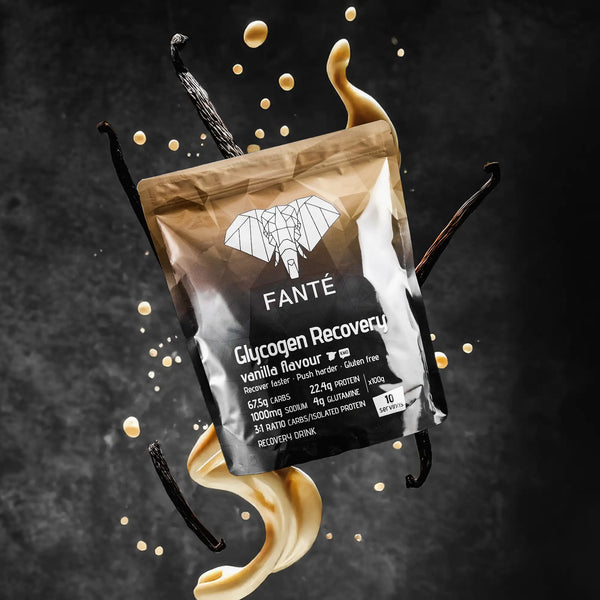
The Glycogen Recovery Drink by FANTÉ is formulated to provide carbohydrates, protein, and electrolytes after demanding sessions, components that are relevant within a sports recovery strategy.
Its formulation combines maltodextrin and fructose as carbohydrate sources, whey protein isolate, electrolytes, and glutamine. FANTÉ uses a 3:1 ratio of carbohydrates to protein and adapts the amount of product to body weight rather than proposing a single dose for all athletes.
It is important to interpret that ratio correctly: scientific evidence does not establish that a 3:1 ratio is necessarily the optimal ratio for all athletes or all situations, but it is true that the 3:1 or 4:1 ratio would be the best ratio in terms of endurance sports. Needs should be determined primarily by the absolute amount of CHO and protein required, the session performed, and the time available until the next training session.
When the priority is rapid glycogen replenishment, achieving sufficient carbohydrate intake is the primary nutritional factor. Protein complements the strategy by providing amino acids necessary for muscle recovery and remodeling processes.
[[PRODUCTO:glycogen-recovery-drink]]
Tart Cherry Recovery Shot: Montmorency sour cherry as a recovery supplement
The Tart Cherry Recovery Shot by FANTÉ combines Montmorency sour cherry concentrate with magnesium bisglycinate, L-theanine, and glycine. According to the formulation declared by FANTÉ, each shot provides 1,000 mg of anthocyanins, 1,250 mg of polyphenols, 3 g of glycine, 200 mg of L-theanine, and 300 mg of magnesium bisglycinate.
The interest in tart cherry in sports nutrition is mainly due to the polyphenolic compounds present in the sour cherry. Different investigations have studied its use around demanding exercise, analyzing variables such as muscle function recovery, muscle soreness, and certain inflammatory markers.
A systematic review and meta-analysis published in 2021 found favorable effects on some recovery indicators after intense exercise. However, the results are not uniform for all variables, so Tart Cherry should be understood as a complementary tool and not as a substitute for rest, proper nutrition, or carbohydrate and protein replenishment.
The most recent scientific evidence also points to possible benefits on certain recovery markers in trained athletes, although there is heterogeneity between protocols, doses, and types of exercise. Therefore, it cannot be stated that Tart Cherry guarantees faster recovery in all athletes, but it can be stated that it is one of the recovery supplements with the greatest potential alongside carbohydrates.
It may be of special interest during periods with high recovery demands, such as demanding training blocks or competitions with efforts close to each other.
[[PRODUCTO:tart-cherry-recovery-shot]]When to use Glycogen Recovery Drink and when to use Tart Cherry?
They do not fulfill exactly the same function. Glycogen Recovery Drink is primarily oriented toward covering nutritional recovery needs, especially carbohydrates for glycogen replenishment and protein for muscle repair and remodeling processes.
Tart Cherry, on the other hand, provides bioactive compounds from the Montmorency sour cherry and other ingredients within a complementary recovery strategy. Evidence on tart cherry is especially interesting in contexts of intense exercise and recovery between efforts, although its effects depend on the protocol and do not appear consistently in all studied markers.
Therefore, there is no need to view them as mutually exclusive products. They can form part of the same recovery strategy when the athlete's needs justify it, always within the context of sufficient nutrition, adequate rest, and correct training planning.
Within the range of muscle recovery products, the choice should correspond to the real needs of each training session. You can also delve into our guide on effective muscle recovery and discover how to recover correctly using a 3:1 ratio.
The fundamental idea is simple: training generates the stimulus, but adaptation requires recovery. Sleeping adequately, periodizing loads, and meeting the needs for energy, carbohydrates, protein, and fluids are the foundations; Glycogen Recovery Drink and Tart Cherry can be integrated as tools within that strategy depending on the context.
Bibliography
Viru A. Postexercise recovery period: carbohydrate and protein metabolism. Scandinavian Journal of Medicine & Science in Sports. 1996;6(1):2-14. doi:10.1111/j.1600-0838.1996.tb00063.x. PMID: 8680938.
Alghannam AF, Gonzalez JT, Betts JA. Restoration of Muscle Glycogen and Functional Capacity: Role of Post-Exercise Carbohydrate and Protein Co-Ingestion. Nutrients. 2018;10(2):253. doi:10.3390/nu10020253. PMID: 29473893.
Craven J, Desbrow B, Sabapathy S, Bellinger P, McCartney D, Irwin C. The Effect of Consuming Carbohydrate With and Without Protein on the Rate of Muscle Glycogen Re-synthesis During Short-Term Post-exercise Recovery: a Systematic Review and Meta-analysis. Sports Medicine - Open. 2021;7:9. doi:10.1186/s40798-020-00297-0. PMID: 33507402.
Burke LM, van Loon LJC, Hawley JA. Postexercise muscle glycogen resynthesis in humans. Journal of Applied Physiology. 2017;122(5):1055-1067. doi:10.1152/japplphysiol.00860.2016. PMID: 27789774.
Moore DR. Nutrition to Support Recovery from Endurance Exercise: Optimal Carbohydrate and Protein Replacement. Current Sports Medicine Reports. 2015;14(4):294-300. doi:10.1249/JSR.0000000000000180. PMID: 26166054.
Ivy JL, Goforth HW Jr, Damon BM, McCauley TR, Parsons EC, Price TB. Early postexercise muscle glycogen recovery is enhanced with a carbohydrate-protein supplement. Journal of Applied Physiology.2002;93(4):1337-1344. doi:10.1152/japplphysiol.00394.2002. PMID: 12235033.
Hill JA, Keane KM, Quinlan R, Howatson G. Tart Cherry Supplementation and Recovery From Strenuous Exercise: A Systematic Review and Meta-Analysis. International Journal of Sport Nutrition and Exercise Metabolism. 2021;31(2):154-167. doi:10.1123/ijsnem.2020-0145. PMID: 33440334.
Rojano-Ortega D, Molina-López A, Moya-Amaya H, Berral-de-la-Rosa FJ. Tart cherry and pomegranate supplementations enhance recovery from exercise-induced muscle damage: a systematic review. Biology of Sport. 2021;38(1):97-111. doi:10.5114/biolsport.2020.97069. PMID: 33795919.
Roberts PA, Fox J, Peirce N, Jones SW, Casey A, Greenhaff PL. Glycogen supercompensation in skeletal muscle after cycling or running followed by a high carbohydrate intake the following days: a systematic review and meta-analysis. 2025. PMID: 40901614.
Daab W, Bouzid MA, Nassis GP, et al. Effects of Tart Cherry Juice Supplementation on Recovery from Exercise-Induced Muscle Damage in Athletes: A Systematic Review and Meta-Analysis. Sports Medicine - Open. 2026;12(1):40. doi:10.1186/s40798-026-00993-3. PMID: 41945263.