
Muscle recovery is essential for any athlete or active person looking to improve performance and prevent injuries. This biological process allows muscles to repair and strengthen themselves after the physical stress caused by exercise.
After a workout, you're fatigued and your performance capacity is low. In the hours and days following the workout, you "recover" and your performance capacity returns to normal (and may even improve).
The time it takes for this process depends on many factors, including, of course, how hard the training was and your previous muscle glycogen stores (glycogen guide) .
Hydration and general nutrition for post-workout muscle recovery
Hydration and nutrition play a critical role in muscle recovery . Fluid loss during exercise can lead to dehydration, negatively impacting muscle function and recovery.
It is essential to replenish lost fluids to facilitate the metabolic processes involved in muscle repair.
The National Association of Sports Nutritionists recommends consuming 15 to 20 ounces (approximately 450 to 600 ml) of water at least two hours before exercise, followed by 8 to 10 ounces (approximately 240 to 300 ml) every 15 minutes during exercise, and replacing 150% of lost body weight in fluids after exercise for optimal recovery.
On the other hand, the “anabolic window” refers to the short period after training when the body is most receptive to nutrients for protein synthesis and muscle recovery .
Consuming a combination of protein and carbohydrates during this window can accelerate muscle recovery by increasing the rate of muscle protein synthesis and replenishing glycogen stores, which we will explain in more detail below.
An optimal ratio is to consume 20 to 25 grams of high-quality protein, such as whey, along with 40 to 60 grams of fast-absorbing carbohydrates, such as fruit or a protein shake, to support muscle and energy recovery .
Acute recovery (first 6-8 hours)
When we only have a few hours for muscle recovery before our next workout and we want to be as prepared as possible, there are several methods we can use to optimize that muscle recovery within the available timeframe.
Nutrition plays an important role, but there are also other methods such as immersion in cold water (ice bath), contrast water therapy (intermittent cold water and hot water, usually 1 min each for about 15 min), massage, stretching and the use of compression garments (1,2,3).
Furthermore, there is a significant psychological component that must be addressed appropriately to ensure that another good performance can be achieved a few hours later (4). Some methods have more evidence than others, but discussing those methods is beyond the scope of this guide. Here, we will focus on nutrition .
Nutritional strategies for muscle recovery
During the exercise session, the athlete may have become dehydrated, depleted glycogen stores, and experienced pain. Nutritional strategies can address any of these issues.
It is recommended to start exercise in a state of euhydration (sufficient fluids, neither excessive nor insufficient)(5,6). The best measure of this is probably body weight.
If you have regular body weight measurements over a longer period of time, you will know what your normal hydrated weight is.
To achieve hydration after exercise , it is often recommended to ingest 120-150% of the fluids per kilogram lost in the 4-5 hours following exercise. In other words, you would need to drink 600 ml/h (for 4-5 hours) for every 2 kg (lost) (7,8,9).
If you want to learn more about how to calculate your rate and what tool you can use to find out, here's a link to our hydration and dehydration rate guide.
To achieve hydration after exercise, it is often recommended to ingest 120%-150% of the fluids you lost in the 5 hours following exercise.
This recommendation is based on the fact that drinking fluids quickly will stimulate urine production and prevent the body from retaining all the necessary fluid. Adding sodium can also contribute to fluid retention.
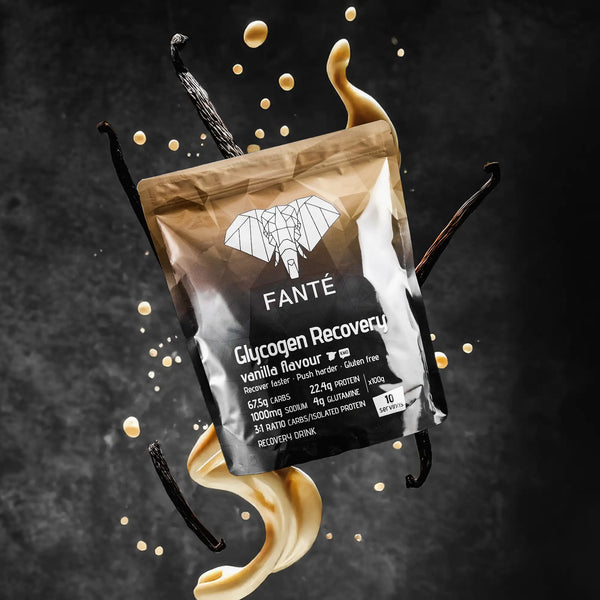
This sodium can come from a recovery drink along with the necessary carbohydrates, proteins and salts, such as our Glycogen recovery drink , or from the food you eat in the hours after exercise, if it has not been very strenuous.(10,11)
[[PRODUCT:glycogen-recovery-drink]]
Such an aggressive hydration strategy for muscle recovery is only necessary when large amounts of fluids are lost and there is another workout scheduled a few hours later.
*In weight-class sports with weigh-ins , these strategies can be crucial.
Glycogen
If you want to learn more about glycogen , we have several guides that will teach you how, how much, and why to replenish it. ( guide: a lot to say about glycogen , guide: how glycogen is stored , guide: staged recovery , and guide: does glycogen threshold exist ?)
During most activities, both muscle and liver glycogen are used. Glycogen stores are important because, below a critical level, they are associated with poor performance, especially at higher intensities.
Very little muscle glycogen is resynthesized within a 2-hour window. This is because ingested carbohydrates are preferentially stored in the liver. When glucose is absorbed, it first enters the liver and can then be stored or transferred to other tissues.
Initially, it will be stored mostly and, as the liver's glycogen stores fill up, more glucose will be passed on to other tissues (muscle).
The process of complete muscle glycogen synthesis will take 24 hours and sometimes longer, especially when there is muscle damage or carbohydrate intake is modest.
Within a 4- to 6-hour window, carbohydrate intake can result in significant elevations in muscle glycogen, and in several studies (not all) this has resulted in improved endurance performance in the second set of exercises.
How to achieve muscle glycogen synthesis?
To achieve muscle glycogen synthesis , carbohydrate intake is essential. The general recommendation is 1.2 g/kg/h for 3-4 hours after exercise to maximize glycogen synthesis.
Regarding the amount of CHO recommended for glycogen replacement, van Loon et al. (10) showed how an intake of 1.2 g/Kg/hour of CHO resulted in a 150% greater glycogen resynthesis (from 17 to 45 mmol/Kg dm/h) compared to a lower dose of 0.8 g/Kg/hour.
Seeking the optimal amount, Howarth et al. (12) showed that an intake of 1.6 g/kg/hour did not further stimulate glycogen resynthesis. Therefore, they considered that the recommended amount of carbohydrate intake after exercise should be around 1.0–1.2 g/kg/hour within the first hour after exercise cessation, and should continue with an intake of 1.0–1.2 g/kg/hour every 4–6 hours or until resuming normal meals (2).
Regarding the ratio, a 2:1 maltodextrin/fructose ratio should be consumed, as explained in the guide ( stage races and how glycogen is stored ), to replenish not only the muscles but also all the body's glycogen stores to 100%. (13,14)
Regarding muscle soreness, there are several strategies to reduce it. Antioxidants have been suggested as helpful, tart cherry juice has been proposed, and protein has also been suggested. There is some evidence to support all of these. However, protein, along with adequate carbohydrates, is paramount when it comes to muscle recovery.
Why protein for muscle recovery?
The use of protein is fully established in the muscle recovery process . Just look at any athlete in their daily routine drinking their protein or "recovery" shake, or the options the industry offers us based on protein-rich products designed specifically for post-exercise.
This is so universal that it seems crazy to even question it. But (let's be critical), from the point of view of glycogen resynthesis , is protein absolutely necessary?
To understand this section, we will differentiate the possible effect of protein in two muscle recovery processes.
Protein synthesis
On the one hand, there is protein synthesis, something that is undoubtedly fundamental for the regeneration of structures damaged during exercise (15) and for the long-term adaptation process of the athlete:
Protein synthesis is a lengthy process that cannot be completed in just a few hours. Therefore, this protein synthesis has little significance in short-term muscle recovery , as it is difficult to repair damaged structures in a few hours.
Looking at it in the long term, protein will be a fundamental ingredient in recovery.
Glycogen resynthesis
And on the other hand, our main concern in this entry, the short-term resynthesis of glycogen .
Protein has no effect (or a very small effect) on glycogen resynthesis as long as there is an adequate amount of carbohydrates available (around 1-1.2 g of carbohydrates/kg of body weight). It is estimated that when there are fewer than 0.8 g of carbohydrates/kg of body weight, protein assists in this glycogen synthesis.
Whey protein isolate , for example, produces an effect on insulin that has been used to support its intake after exercise (16). However, compared to the combination of sugars discussed previously, this effect is not significant in either anabolism or glycogen resynthesis.
Protein can slow gastric emptying, which is crucial for rapid muscle recovery . Therefore, 2:1 or 1:1 (carbohydrate:protein) or 0:1 (protein only) ratios offer no benefit when it comes to glycogen restoration. In other words, it's incomplete recovery.
The effects of various insulinotropic amino acids and their anabolic effects on glycogen resynthesis have been studied, but no beneficial results have been observed. Currently, their true effect on muscle recovery is unknown.
Muscle recovery: Athlete priorities
Therefore, when it comes to recovering and optimizing glycogen "filling" , we must be very clear about the athlete's priorities.
- Short-term recovery: Rehydration and rapid carbohydrate intake are key. Protein intake can be omitted if the competition is within a few hours and the main objective is glycogen replenishment.
- Medium- to long-term recovery: Aside from hydration and substrate refueling, protein intake is essential for protein synthesis and muscle recovery. However, the order can also depend on priorities. In a Tour de France, for example, both rapid and later protein intake might be beneficial, depending on substrate availability and the possibility of consuming protein while cycling, for instance.
So, how do I regain muscle mass?
Therefore, once the context regarding the most effective and rapid "replenishment" of muscle and liver glycogen is understood, we add the following practical proposal for muscle recovery :
Short-term muscle recovery (0-8 h): Absolute priority to carbohydrate intake, as soon as possible, in an amount of 1-1.2 g HC/kg/hour with a combination of sugars (Maltodextrin + Fructose) in a minimum ratio of 2:1. Frequent (every 15-30 minutes) and small intakes.

The following table shows how the recommended dosage of Fanté GLYCOGEN varies according to body weight. The heavier you are, the more you will need, because larger individuals can store greater amounts of glycogen and essentially have more muscle mass to repair and replenish.
As you'll see, this usage mode is exclusive to Fanté GLYCOGEN ; nothing similar exists, and it's not recommended to use this mode with any other recovery product on the market. If you'd like to learn more, we recommend checking out the usage modes for our Fanté products, categorized by intensity and duration.

Literature
- Beelen M, Burke LM, Gibala MJ, Van Loon L JC (2010) Nutritional strategies to promote post exercise recovery. Int J Sport Nutr Exerc Metab Dec 20(6):515-32.
- Burke LM, Collier GR, Beasley SK, Davis PG, Fricker PA, Heeley P and Hargreaves M (1995) Effect of coigestion of fat and protein with carbohydrate feedings on muscle glycogen storage. Journal Applied Physiology, 76(6) 2187-2192.
- Fallowfield JL, Williams C, Singh R. (1995) The influence of ingesting a carbohydrate-electrolyte beverage during 4 hours of recovery on subsequent endurance capacity. Int J Sport Nutr 1995; 5: 285-99.
- Ivy Jl, Katz AL, Cutler Cl, Sherman WM, Coyle EF (1988) Muscle glycogen synthesis after exercise: effect of time of carbohydrate ingestion. Journal Applied Physiology. Apr:64(4)1480-5.
- Wallis GA, Hulston CJ, Mann CH, Roper HP, Tipton KD, Jeukendrup AE. (2008) Postexercise muscle glycogen synthesis with combined glucose and fructose ingestion. Med Sci Sports Exerc. Oct;40(10):1789-94.
- Décombaz J, Jentjens R, Ith M, Scheurer E, Buehler T, Jeukendrup A, Boesch C. (2011) Fructose and galactose enhance postexercise human liver glycogen synthesis. Med Sci Sports Exerc. 2011 Oct;43(10):1964-71.
- Betts JA, Williams C. (2010) Short-Term recovery from prolonged exercise. Sports Medicine. 40(11)941-959.
- Beelen M, Burke LM, Gibala MJ, Van Loon LJC. (2010) Nutritional strategies to promote post exercise recovery. Journal of Physical Activity and Health.
- Jentjens, RL, van Loon, LJ, Mann, CH, Wagenmakers, AJ, & Jeukendrup, AE (2001). Addition of protein and amino acids to carbohydrates does not enhance postexercise muscle glycogen synthesis. Journal of Applied Physiology), 91(2), 839–846
- Van Loon, L.J., Saris, W.H., Kruijshoop, M., & Wagenmakers, A.J. (2000b). Maximizing postexercise muscle glycogen synthesis: Carbohydrate supplementation and the application of amino acid or protein hydrolysate mixtures. The American Journal of Clinical Nutrition, 72(1), 106–111
- Gibala, M.J. (2007). Protein metabolism and endurance exercise. Sports Medicine (Auckland, NZ), 37(4–5), 337–340.
- Howarth, KR, Moreau, NA, Phillips, SM, & Gibala, MJ(2009). Cogestion of protein with carbohydrate during recovery from endurance exercise stimulates skeletal muscle protein synthesis in humans. Journal of Applied Physiology (Bethesda, Md.), 106(4), 1394–1402.
- Tang, J.E., & Phillips, S.M. (2009). Maximizing muscle protein anabolism: The role of protein quality. Current Opinion in Clinical Nutrition and Metabolic Care, 12(1), 66–71.
- Dangin, M., Guillet, C., Garcia-Rodenas, C., Gachon, P., Bouteloup-Demange, C., Reiffers-Magnani, K., . . . Beaufrère,B. (2003). The rate of protein digestion affects protein gain differently during aging in humans. The Journal of Physiology, 549(Pt. 2), 635–644.
- Zawadzki, KM, BB Yaspelkis III, and JL Ivy. (1992). Carbohydrate-protein complex increased the rate of muscle glycogen storage after exercise. J Appl Physiol 72:1854-59.
- Burke, E.R. PhD (1999). D-Ribose, what you need to know. Avery Publishing Group.
- Paswater, RA PhD and Fuller, J. PhD (1997). Building Muscle Mass, Performance And Health With HMB. Keats Publishing.