
The half marathon is the race every athlete wants to tackle as their first competition.
But before we get into the explanation, if you're also planning to run a Marathon, I recommend you read this guide where we explain some differences compared to the half marathon. Click here
It's a distance where glycogen stores are significantly affected since the duration of the event exceeds one hour. Therefore, the correct intake of sports nutrition during the race is essential to finish in good condition.
Before you start training, you need to know that you will be subjecting your body to a large volume of kilometers and stress. Hence, it's important that you know your body will be prepared for it. Additionally, your body will be under stress, meaning you'll need to recover well after each training session. It's not just about what to eat pre-workout, during the day, or during the workout; post-workout recovery in this kind of preparation is vital if we want to progress. With the Glycogen recovery drink you'll get the right amount of carbohydrates and proteins, as we've explained in previous guides on How to recover?, to help you with assimilation from training to training and thus be able to increase weekly training volume without loss of performance or increased risk of injury.
[[COMUNIDAD_CTA]]
Periodized nutrition
What do we mean by periodized nutrition?
This term is not very common among amateur runners, but it is increasingly seen among regular runners of events like half marathons. Periodized nutrition simply means giving your body what it needs at different times of the season. As nutritionists, we must know that both amateur and professional runners have completely different requirements between a training volume phase and a specific intensity phase.
That is why, just as we emphasize the 1:0.8 ratio or the maximum tolerable carbohydrate concentration of energy drinks of all our products, science also has something to say about it.
The adaptive response to physical training is determined by a combination of factors:
-duration
-intensity
-type of exercise
-training frequency
-quality and quantity of nutrition before and after exercise
It is increasingly clear that adaptations, initiated by exercise, can be amplified or attenuated by nutrition. For example, it is well established that in the absence of protein feeding after exercise, net protein synthesis is low and muscle can actually have a negative protein balance, preventing proper recovery.
There is also evidence that reducing carbohydrate availability can promote specific adaptations in the muscle. Conversely, high-dose antioxidant supplementation has the potential to reduce training adaptations [ 1 , 2 , 3 ].
During certain training periods, there is a focus on weight control and lower energy intake, such as during the preseason, while during other periods, such as specific volume or intensity mesocycles, there is a focus on recovery and performance and a higher carbohydrate intake. Mujika et al. [ 4] concluded that “nutrition should be periodized and tailored to support changes in individual goals, training levels, and requirements throughout a season and/or training cycle.”
Hawley and Burke [ 5] discussed the importance of a long-term periodized training and nutrition program as a way to improve performance. The authors stated that “…it seems interesting to suggest that competitive or amateur athletes may manipulate carbohydrate availability before, during, or after selected training sessions that are part of a long-term periodized training-nutrition plan to promote metabolic adaptations to training.” In this statement, there is a strong focus on carbohydrate availability as a driver of training effects.
PRE-SEASON NUTRITIONAL REQUIREMENTS
It is important to clarify that the preseason is a time of year when every athlete uses it to rest psychologically from competitions or simply reduces their sports activity due to extracurricular commitments or holidays.
These are times when the body does not require a very high intake of carbohydrates or proteins. In addition, glycogen reserves are usually reduced due to the lack of muscle stimulation. Therefore, it is important to control the intake of at least macronutrients on a daily basis.
Carbohydrates: 2.5 to 3.5 grams/kg/day
Proteins: 1 gram/kg/day
Fats: 0.7 grams/kg/day
If you don't know how to calculate your daily calories, you can take a look at the currently popular applications for macronutrient calculation. This way, you can control your intake day by day so that after a few weeks, you'll know and manage your intake without needing an application to track it.
SEASON REQUIREMENTS (SPECIFIC MESOCYCLE 1 AND 2) VOLUME AND INTENSITY
During these times, the body needs to primarily use slow and fast-digesting carbohydrates. That is, the diet should be based on complex foods during hours far from training, such as whole wheat pasta or brown rice, and simple carbohydrates during hours close to training, such as white rice, white pasta, white bread, jam, etc.
In other words, the diet should consist of fruits and vegetables to maintain high levels of minerals and vitamins, but with an emphasis on high-carbohydrate foods.
Carbohydrates: 6 to 9 grams/kg/day
Proteins: 1 to 1.4 grams/kg/day
Fats: 0.5 to 0.7 grams/kg/day
COMPETITION REQUIREMENTS
In competition, or the week before competing, one thing must be clear: without carbohydrates, a person does not perform at 100%. This is something that pseudoscience has recently emphasized, suggesting that fats are the most beneficial substrate for endurance sports. We have already clarified this with our ketogenic diet and performance guide, so we will not debate it further.
For competition-like training, whether in intensity or duration, you should use this type of daily macronutrient distribution to meet your needs.
Carbohydrates: 7 to 12 grams/kg/day
Protein: 0.8 to 1 gram/kg/day
Fats: 0.5 to 0.7 grams/kg/day
It should be clarified that the difference in distribution between the day before competition and the day you do a specific competition-like training is that for the former, you should follow a diet almost without fiber (tapering, learn more about how to prepare a tapering the day before) and for the latter, you can ingest some fiber and a bit more protein since you will be training on that day and not the day before competition.

1 SAME EXAMPLE WITH DIFFERENT PROPORTIONS

HOW TO MANAGE PRE-COMPETITION NUTRITION?
In previous guides, we explained how to perform a tapering, so if you have doubts about what to eat the day before, read this guide before continuing.
A tapering for a half marathon is even more interesting than for a marathon. Primarily for two reasons:
Firstly, when an athlete trains for 1 hour, they sometimes don't consume anything, so their energy comes exclusively from glycogen, the primary energy source we obtain through tapering.
And secondly, in a half marathon, our reserves could be depleted in just 40 minutes due to the intensity, compared to a marathon.
We will focus on what, how, and how much to eat for breakfast before a half marathon
It's important to have a good breakfast on race day. Too much or inappropriate food can lead to stomach problems. And too little could leave you without energy prematurely. Science can provide some guidance on carbohydrate intake and other nutrient intake, but much depends on individual preferences. Let's look at several important factors to consider when planning your race day breakfast...
Carbohydrates are the most important macronutrient to include in your race day breakfast because your body will rely heavily on them as a fuel source during the race. The body can only store a limited amount of glycogen in the liver, and overnight hepatic glycogen stores are substantially reduced (6). Therefore, the intake of simple carbohydrates hours before the marathon is crucial.
It is recommended to consume 1 to 4 grams of carbohydrates per kg of body mass in the 1 to 4 hours before exercise (7). This is a fairly wide range, which can lead to a variety of scenarios. For example, a person could consume 1 g/kg of carbohydrates 4 hours before a race, while another could consume 4 g/kg of carbohydrates 1 hour before the race, and both would meet the recommendations. It seems sensible to consume a larger meal if there is more time before the start and a smaller meal if less time is available.

Everyone is different in terms of the amount and timing of carbohydrate intake before a race, and therefore, recommendations should be tailored to individual preferences. High-carbohydrate foods include toast, bagels, porridge, cereals, rice, Scottish pancakes, cereal bars, and bananas.
If you have trouble digesting food before a race, even when you allow a significant gap between eating and running, try liquid forms of carbohydrates. For example, a sports drink like our GLUT 5 DRINK carbohydrate drink or a commercial smoothie. Both solid and liquid forms of carbohydrates similarly promote glycogen resynthesis after an overnight fast, making them equally suitable options (8)
Foods to avoid or limit?
Certain foods can increase the likelihood of experiencing stomach discomfort during a race, particularly fiber. This is because fiber takes longer to digest, which can mean it may still be in your stomach when you are at the starting line. Lower glycemic index (GI) carbohydrates often have a higher fiber content. Therefore, reducing low GI carbohydrates in your pre-race breakfast can alleviate symptoms (if you are prone to them), for example, whole-wheat bread, bran flakes, oatmeal, muesli, rye bread.
Consuming too much fat before the race can also cause intestinal problems because it slows down the rate at which food empties from the stomach (8). Ideally, when the race starts, the breakfast carbohydrates should be stored and not still in the stomach. You can avoid a high-fat breakfast by not including bacon, sausages, cheese, and pastries. Of course, the longer the time between breakfast and the start, the less important this will be.
DURING THE HALF MARATHON
We will focus on carbohydrates, hydration, and salts in a general way. As we have already mentioned in previous guides, each athlete should individualize the three important points: carbohydrates, salts, and water. In just 2 weeks, we will have the Half Marathon pack available, like the Marathon pack that is already available, with which you will have everything you need for race day: pre, during, and post, with a sticker of the strategy so you can follow it perfectly throughout the half marathon and never forget what you should eat or drink.
[[PRODUCTO: pack-medio-maraton-fante]]
Carbohydrates:
Individualization is the key to success, but every athlete should consume between 40 to 60 grams of carbohydrates per hour in a marathon, or at least 1 Gel 60 per hour. That is, if the half marathon lasts 2 hours, you should consume 2 Gels 60 in total.
[[PRODUCTO:gel-60]]
If we go beyond the basic carbohydrate needs per hour, the athlete who manages to consume more than 60 grams of carbohydrates per hour throughout the season will be very efficient in performing better. Because if we talk about performance, the athlete who has trained their stomach to consume 70 to 80 grams of carbohydrates per hour during a marathon may improve their time more easily than an athlete who consumes the minimum recommended.
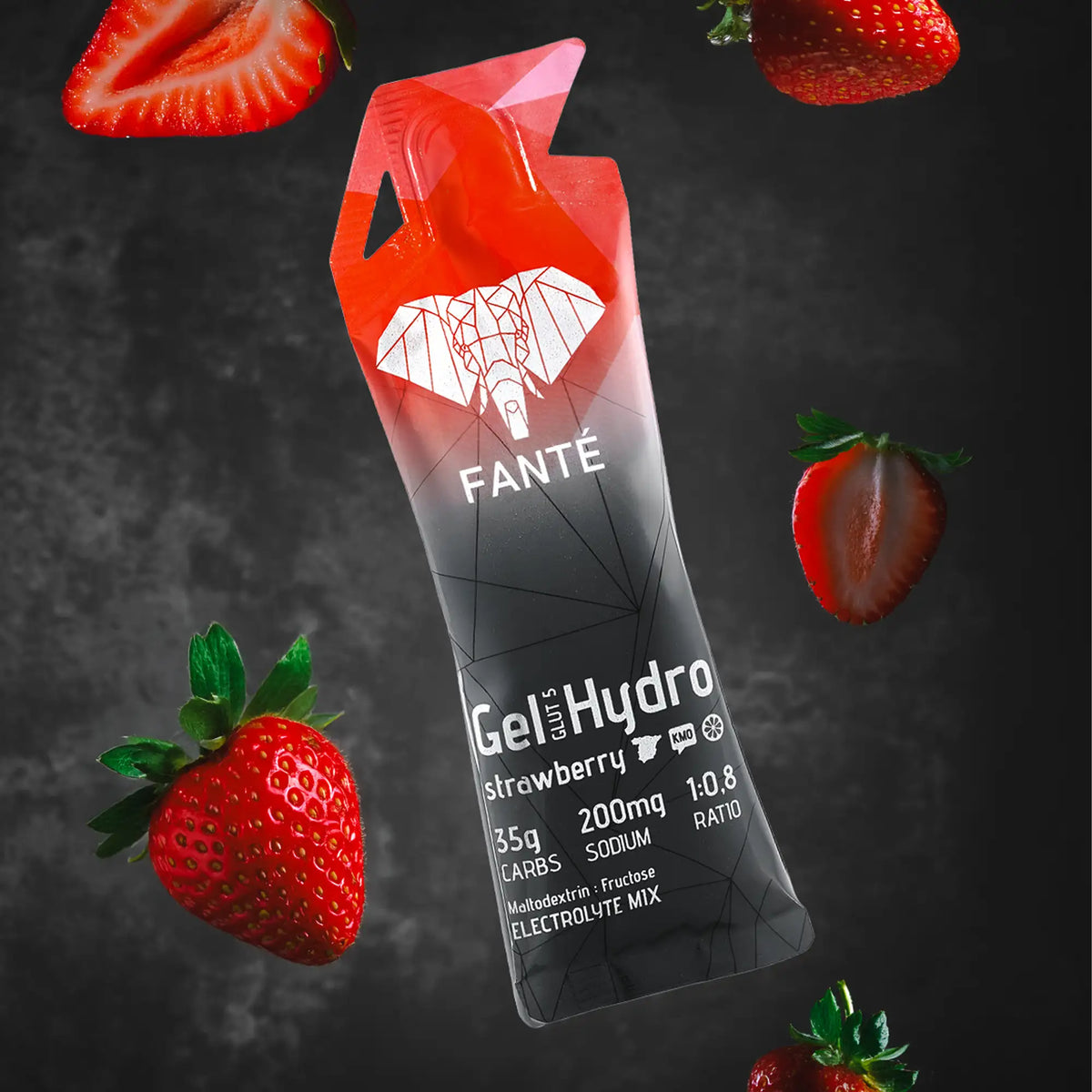
In this case, they could use another strategy with the Gel hydro 35 strawberry and banana. One unit every 30 minutes will provide the athlete with 70 grams of carbohydrates per hour and 400mg of sodium. This ensures that both sodium and carbohydrates are covered at all times, providing energy for the entire race.
Hydration
Regarding hydration, an athlete should consume at least 300 to 550ml of water per hour to compensate for sweat losses.
However, for distances like the half marathon, which most athletes complete in under an hour and a half, there would be no need to include a 500ml or 250ml soft flask with water. Only hydration from aid stations would be necessary. This is because to reach the finish line with dehydration exceeding 3%, one would have to lose more than 1 liter per hour, and depending on the time of year, this might not be necessary.
However, if you are an athlete who sweats a lot and knows you could lose more than 3% of your body weight in sweat during the event, we recommend calculating your sweat rate. Here is a guide on how to calculate it: How to calculate your dehydration rate? where you can download this FANTÉ calculator created by our nutritionists, which will allow you to easily calculate your optimal water consumption per hour.
With the aim of knowing how much hydration you would need in a half marathon.
Salts
During a half marathon or any endurance event, we should consume at least 350 to 450mg of sodium per hour, as this is the minimum amount of sodium our body needs to maintain osmotic balance.
For this reason, FANTÉ has created the Gel 60 range, with which 1 gel per hour allows you to consume 60 grams of carbohydrates and 350mg of sodium, the minimum amount per hour you need to perform at your best.
On the other hand, if you are an athlete for whom texture is a priority, we have created the Gel Hydro 35 range, specifically for Trail and running, as its liquid texture makes gels easier to consume and assimilate. In both ranges, you will find the minimum sodium required per hour and the minimum amount of carbohydrates per hour needed for your body to perform at its best.
Caffeine
Before explaining how we should manage caffeine consumption, we recommend that you read our guide caffeine top-up, which explains how we should ingest caffeine in long-distance and medium-distance races.
For a half marathon, caffeine is an essential supplement if we want to perform at our best. It is the supplement with the most scientific evidence behind it.
If the race lasts up to 1:30h
The athlete should only consume 1 60 caff gel pre-race 10 minutes before the start.
If the race lasts more than 1:30h
The athlete should consume 1 caffeine pill or 1 60 caff gel 15 minutes before the start and 1 Glut 5 Lite 100CAFF gel at 1:20h.
NUTRITIONAL STRATEGY EXAMPLE
If you want an individualized strategy according to your professional and personal conditions, your training level and your nutrition level, our new nutritional advice is an innovative product never before seen in nutrition brands. Our nutritionists will create an individualized and specific strategy for you, with which you will receive a PDF with the entire strategy and a video explaining first-hand by our nutritionists every detail of the strategy so that you have no doubts.
If you prefer a specific pack for a half marathon, it will be available on our website in a few weeks.
If you prefer a ready-made and planned marathon pack, get our MARATHON pack, depending on your athletic level you can choose level 1, level 2 or level 3, and depending on the level you choose you will have one strategy or another. The aim is to individualize the pack as much as possible so that each athlete goes into the race day in the best conditions.
In the same way, here is a general example that meets all the conditions explained above

Bibliography
- Paulsen G, Cumming KT, Holden G, et al. Vitamin C and E supplementation impairs the cellular adaptation to endurance training in humans: a controlled, randomized, double-blind trial. J Physiol. 2014;592:1887–901
- Paulsen G, Hamarsland H, Cumming KT, et al. Vitamin C and E supplementation alters protein signaling after a strength training session, but not muscle growth during 10 weeks of training. J Physiol. 2014;592:5391–408.
- Morrison D, Hughes J, Della Gatta PA, et al. Vitamin C and E supplementation prevents some of the cellular adaptations to endurance training in humans. Free Radic Biol Med. 2015;89:852–62
- Mujika I, Stellingwerff T, Tipton K. Nutrition and training adaptations in aquatic sports. Int J Sport Nutr Exerc Metab. 2014;24:414–24.
- Hawley JA, Burke LM. Carbohydrate availability and training adaptation: effects on cellular metabolism. Exerc Sport Sci Rev. 2010;38:152–60.
- Rothman DL, Magnusson I, Katz LD, Shulman RG, Shulman GI. Quantification of hepatic glycogenolysis and gluconeogenesis in fasting humans with 13C NMR. Science (80- ). 1991
- Thomas DT, Erdman KA, Burke LM. Position of the Academy of Nutrition and Dietetics, Dietitians of Canada, and the American College of Sports Medicine: Nutrition and Athletic Performance. J Acad Nutr Diet. 2016;116(3):501–28.
- Keizer HA, Kuipers H, van Kranenburg G, Geurten P. Influence of liquid and solid meals on muscle glycogen resynthesis, plasma fuel hormone response, and maximal physical work capacity. Int J Sports Med. 1987;
- Gentilcore D, Chaikomin R, Jones KL, Russo A, Feinle-Bisset C, Wishart JM, et al. Effects of fat on gastric emptying and glycemic, insulin, and incretin responses to a carbohydrate meal in type 2 diabetes. J Clin Endocrinol Metab. 200