
What you should know before your first marathon: A complete preparation guide
Preparing for your first marathon is one of the most demanding and exciting challenges in running.
It’s not just about accumulating mileage. Preparation involves training, nutritional strategy, recovery, rest, and mental planning.
Knowing what you should do before your first marathon can make all the difference between enjoying the experience and suffering in the final kilometers.
In this complete guide, we explain everything you need to know to arrive on race day with confidence.
[[COMUNIDAD_CTA]]
How to prepare for your first marathon without making mistakes
Preparing for a first marathon doesn’t start the week before.
For most runners, a realistic plan usually ranges between 12 and 16 weeks, depending on prior fitness level and goal.
The main pillars are:
-
mileage progression
-
long runs
-
quality workouts
-
strength training
-
recovery
-
nutrition
One of the most frequent mistakes is increasing weekly volume too quickly.
In a marathon, consistency is more valuable than intensity.
How many weeks you need to prepare for your first marathon
As a reference:
-
beginner → 14–16 weeks
-
regular runner → 12 weeks
-
target time → 12–16 weeks with specific blocks
The priority is not just to run more, but to adapt to long runs and accumulated impact.
Long runs and tapering: two key blocks
Long runs are the core of preparation.
Here you train:
-
muscle endurance
-
fat utilization
-
gel strategy
-
digestive tolerance
-
hydration
However, tapering is just as important.
The last 2–3 weeks should gradually reduce the load to arrive fresh on marathon day.
Many mistakes in a first marathon come from training too much until the very end.
What to eat for breakfast before a marathon
Breakfast is one of the most important aspects.
It should achieve three goals:
-
replenish liver and muscle glycogen
-
avoid digestive discomfort
-
ensure stable energy
Ideally, it should be eaten 2–3 hours before.
You can find an excellent reference in this video where we tell you about the perfect marathon breakfast, explaining exactly how to structure it.
We usually prioritize:
-
easy-to-digest carbohydrates
-
low fiber
-
low fat
-
good hydration
Nutrition during your first marathon
This is probably the factor that determines the most races.
The marathon nutrition strategy should be practiced beforehand during long runs.
The usual recommendation is to aim for:
-
30–60 g CHO/h for beginners
-
60–90 g/h for more experienced runners
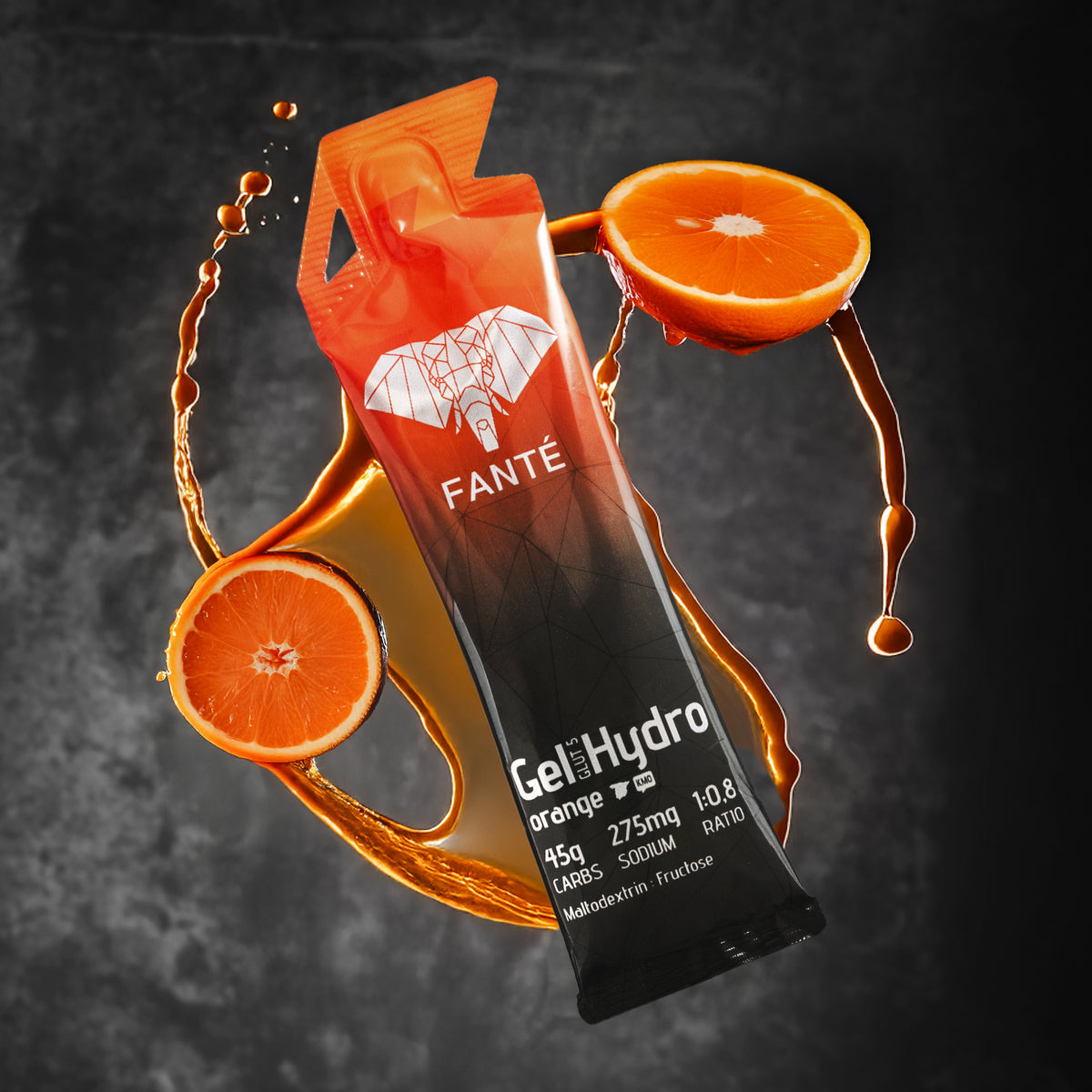
Here, energy gels play a fundamental role.
The important thing is to start early.
Don't wait until you feel fatigued.
A good reference is to take the first serving between 30 and 40 minutes.
[[PRODUCTO:gel-60]]
[[PRODUCTO: gel-lite-30]]
Hydration: the big mistake of the first marathon
Many runners focus only on food and forget about hydration.
Especially if it's hot, hydration should be part of the strategy.
You should consider:
-
water
-
sodium
-
aid stations
-
individual sweat rate
Drinking too much can also be a problem.
The strategy must be individualized.
[[PRODUCTO: glut-5-drink]]
What to expect at kilometer 30
This is where the marathon truly begins.
If preparation or nutrition has failed, the dreaded "wall" usually appears.
Therefore, in a first marathon, arriving with well-managed glycogen reserves is key.
The usual sensation is:
-
increased perceived effort
-
loss of pace
-
accumulated muscle fatigue
This doesn't always mean the race is lost.
A good gel and pacing strategy can help you maintain your rhythm.
Most frequent mistakes in your first marathon
The mistakes we see most often are:
-
starting too fast
-
not having a good breakfast
-
trying new gels
-
not hydrating
-
training too much until the end
-
not respecting the tapering period
Avoiding these mistakes significantly increases the likelihood of enjoying the experience.
Complete marathon guide: recommended video
If you want to delve even deeper into the entire process, we have a complete marathon guide on YouTube that explains training, nutrition, preparation, and race strategy.
It's an excellent resource to complement this guide.
Conclusion
Your first marathon is not prepared with miles alone.
It is built with:
-
smart training
-
planned nutrition
-
rest
-
strategy
The key is not to arrive more tired.
The key is to arrive better prepared.
Because the marathon doesn't start at the starting line.
It starts many months before.
Bibliography
-
Burke LM, Hawley JA, Wong SHS, Jeukendrup AE. Carbohydrates for training and competition. Journal of Sports Sciences. 2011;29(S1):S17–S27.
-
Jeukendrup AE. Training the gut for athletes. Sports Medicine. 2017;47(Suppl 1):101–110.
-
Pitsiladis YP, et al. The marathon race: physiology and performance. Sports Medicine. 2004;34(7):465–485.
-
Hawley JA, Burke LM. Peak performance: training and nutritional strategies for sport. Allen & Unwin. 1998.