When we talk about recovery in endurance sports, few strategies have garnered as much interest in recent years as tart cherry.
But beyond the marketing, the real question is:
What are the true benefits of tart cherry according to scientific evidence?
And even more importantly:
What is tart cherry used for in a real-world sports performance context?
In this article, we analyze what science says, when to use it, and in what situations it can make a difference.
[[PRODUCTO:tart-cherry-recovery-shot]]
What is tart cherry?
Tart cherry refers to the sour cherry, a different variety from the sweet cherry we usually consume.
Its interest in sports is due to its high content of:
- Anthocyanins
- Polyphenols
- Compounds with antioxidant effects
These compounds are directly related to the main benefits of tart cherry in recovery and muscle health.
Sour cherry vs. sweet cherry: key differences
Not all cherries are the same.
Sweet cherry has a profile more oriented toward general consumption, while tart cherry stands out for its density of bioactive compounds.
Main differences:
- Higher concentration of polyphenols
- Greater antioxidant capacity
- Greater anti-inflammatory potential
Therefore, when we talk about what tart cherry is used for, we always refer to the sour variety, specifically the Montmorency variety.
Why the Montmorency variety is the most studied
Among tart cherries, the Montmorency variety is the most used in scientific studies.
This is because it presents:
- High concentration of anthocyanins
- Stable profile in extracts
- Reproducibility in research
Most studies that analyze the benefits of tart cherry in athletes use this variety, making it the reference standard.
Benefits of tart cherry supported by scientific evidence
The benefits of tart cherry are well-documented in the context of sports recovery.
Below, we analyze the most relevant ones.
Reduction of delayed onset muscle soreness (DOMS)
Muscle damage after intense efforts generates what we know as DOMS.
Tart cherry consumption has been shown to:
- Reduce pain perception
- Decrease muscle damage
- Accelerate subjective recovery
This is especially relevant in endurance sports with high eccentric loads, such as running.
Faster recovery between training sessions
One of the main benefits of tart cherry is its impact on recovery between sessions.
By reducing oxidative stress and inflammation, it allows for more frequent training, improves the quality of sessions, and reduces fatigue accumulation.
This is key during periods of high load or competition preparation.
Anti-inflammatory and antioxidant effect of anthocyanins
Anthocyanins are at the core of tart cherry's effect.
They act as:
- Modulators of oxidative stress
- Regulators of the inflammatory response
This explains why tart cherry is so widely used in recovery strategies. However, this effect must be correctly contextualized (we will see this later).
Improved sleep quality in athletes
Another benefit of tart cherry is its impact on rest.
Some studies have shown that it improves both sleep duration and quality, and there is also a possible relationship with natural melatonin.
This makes it an interesting tool in recovery or competition phases.
What is tart cherry used for in endurance sports?
When we analyze what tart cherry is used for, we must understand its main function: to improve recovery, not direct performance during exercise.
Running and trail running: practical application
In disciplines such as running or trail running, tart cherry is primarily used:
- After intense workouts
- After long runs
- During high-load weeks
Its objective is to:
- Reduce muscle damage
- Accelerate recovery
- Allow for training continuity
Cycling and triathlon: when and how to use it
In cycling and triathlon, where volume is often high, tart cherry is integrated as:
- Post-workout tool
- Strategy during loading blocks
- Recovery after competition
In this context, the benefits of tart cherry focus on improving the ability to repeat efforts on consecutive days.
Can tart cherry be used during exercise?
This is where one of the most important and least explained points comes in.
Polyphenols and carbohydrate absorption
Some studies have observed that certain polyphenols can:
- Reduce glycemic response
- Decrease insulin
- Affect hormones like GIP
One hypothesis is that they could partially inhibit intestinal transporters such as SGLT1 or GLUT2.
This implies that, during exercise, they could interfere with carbohydrate absorption, and therefore, compromise the energy strategy.
The myth of "resetting" during exercise
Some brands talk about "resetting the body" during exertion.
From a physiological perspective, this is not that simple.
During exercise:
- Inflammation is an adaptive signal
- Oxidative stress has a regulatory function
Reducing these processes at that moment might not always be beneficial.
Therefore, when analyzing what tart cherry is used for, we must clearly differentiate: recovery vs. intervention during exertion.
When it DOES make sense to use it
Tart cherry makes sense when:
- You are looking to improve recovery
- Do you want to reduce muscle damage?
- You need to optimize rest
It is not a tool designed to be used as an energy source or for "resetting" during exercise, as there is no scientific evidence approved or demonstrated by external organizations or nutrition brands that supports its use.
Field tests are not scientific studies, especially if they are not published, as they cannot be reviewed by the scientific community; therefore, we would not recommend it.
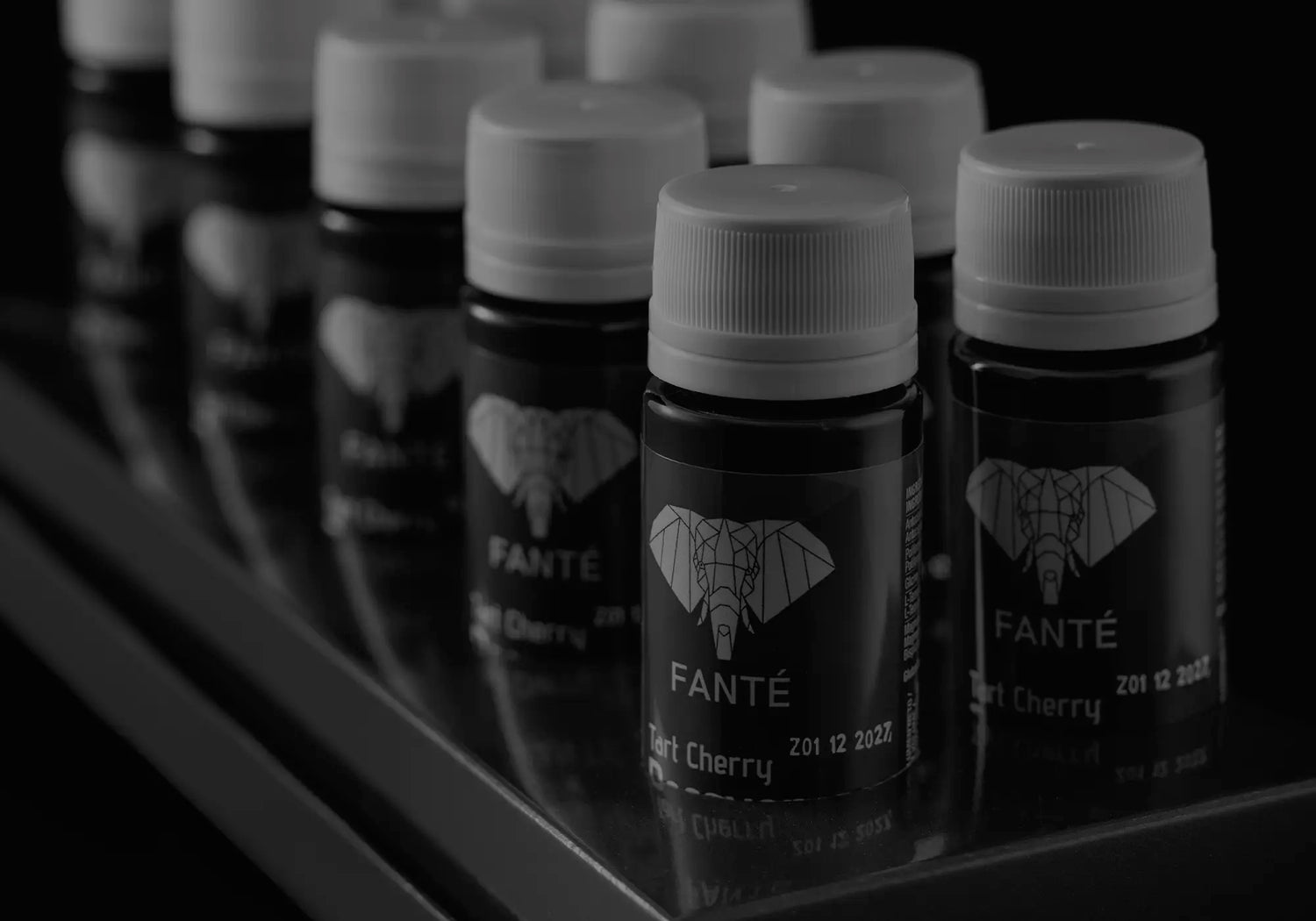
Tart Cherry Recovery Shot by FANTÉ: Science applied to recovery
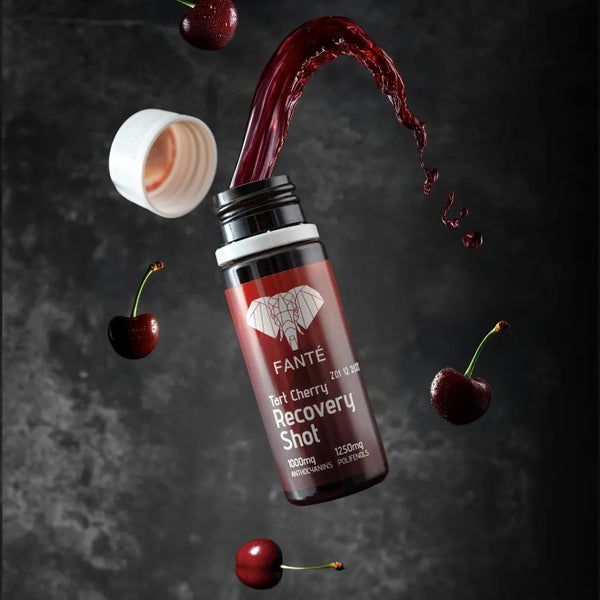
Fanté's Tart Cherry Recovery Shot is formulated under this principle:
Apply scientific evidence at the right time.
It includes:
- Montmorency cherry extract
- High concentration of anthocyanins and polyphenols, the most concentrated on the market
But we don't stop at recovery and its antioxidant power; we add glycine, L-theanine, and magnesium bisglycinate to help us with 360-degree recovery.
That's why we call it Tart Cherry Recovery Shot, as it is a formulation based on recovery and not just on concentrated sour cherry as commonly found in the sports nutrition market.
Its use is intended for:
- Post-workout
- Post-competition
- Loading phases
- Phases where you prioritize 100% rest
You can complement it with other Fanté muscle recovery products within a complete strategy.
Additionally, if you want to delve deeper into the overall context, you can read about the
benefits of muscle recovery and the role of essential micronutrients for athletes.
If you want to read more information about tart cherry, its benefits, or its harmful role in carbohydrate absorption during exercise and why it is counterproductive, check the bibliography.
Bibliography
- Bell PG, Stevenson E, Davison GW, Howatson G. The effects of Montmorency tart cherry concentrate supplementation on recovery following prolonged, intermittent exercise. Nutrients.
- Howatson G, et al. Influence of tart cherry juice on indices of recovery following marathon running. Scandinavian Journal of Medicine & Science in Sports.
- McHugh MPc, et al. The effects of a tart cherry beverage on strength recovery after eccentric exercise. Journal of the International Society of Sports Nutrition.
- Vitale, Kenneth C. MD; Hueglin, Shawn PhD, RD; Broad, Elizabeth PhD, APD. Tart Cherry Juice in Athletes: A Literature Review and Commentary. doi: 10.1249/ JSR.0000000000000385
- Sheau C. Chai, Kristina Davis, Zugui Zhang, Longying Zha, and Kenneth F. Kirschner. Effects of Tart Cherry Juice on Biomarkers of Inflammation and Oxidative Stress in Older Adults. doi: 10.3390/nu11020228
- Jinwook Chung, Minkyung Choi, and Kihyuk Lee. Effects of Short-Term Intake of Montmorency Tart Cherry Juice on Sleep Quality after Intermittent Exercise in Elite Female Field Hockey Players: A Randomized Controlled Trial. Published online 2022 Aug 18. doi: 10.3390/ijerph191610272
- Seyedeh Parisa Moosavian, Maryam Maharat, Mahla Chambari, Fateme Moradi, Mehran Rahimlou. Effects of tart cherry juice consumption on cardio-metabolic risk factors: A systematic review and meta-analysis of randomized-controlled trials. doi: 10.1016/j.ctim.2022.102883