Maintaining carbohydrate availability is a key challenge in multi-stage races. Races like the Marathon des Sables, Tour de France, Vuelta a España, or an Ultraman are all events where one of the main nutritional goals is recovery. The better and faster your recovery, the better your performance will be the next day.
It's well known that there are thousands of recovery supplements available today, each very different from the others. This can be confusing for many athletes, as they don't know which one to choose from. In this guide, we want to help you learn how to choose the best recovery supplement available: GLYCOGEN. This recovery supplement has been scientifically designed by nutritionists specializing in endurance sports nutrition. We're not pressuring you to buy our recovery supplement; our main goal is for you to understand how, how much, and when to take a recovery supplement, so you can make an informed choice.
[[CTA_COMMUNITY]]
A major challenge in multi-stage races, such as cycling Grand Tours and the Marathon des Sables, is maintaining adequate carbohydrate availability. This is because we rapidly deplete carbohydrate stores during exercise and have a limited capacity for carbohydrate storage. Furthermore, when carbohydrate stores are low, we struggle to maintain exercise intensity at race pace. The primary storage form of carbohydrates in humans is glycogen, found mainly in the muscles and liver. It is believed that the maximum amount of glycogen an athlete can store is less than 3,500 kcal of energy. This is insufficient to sustain even a full day of racing, and even if athletes consume carbohydrates during exercise, they will almost always end up with low glycogen stores at the end of each stage. Therefore, muscle glycogen recovery depends primarily on the amount of carbohydrates ingested post-race or training session and their frequency over time.
Sports nutrition guidelines for exercise recovery typically state that to quickly replenish energy, athletes should aim to consume 1.0–1.2 grams of carbohydrates per kilogram of body mass per hour during the first four hours after exercise (1) . This means that a 70 kg person should be consuming around 70–84 grams of carbohydrates.
This is based on substantial evidence that this rate of carbohydrate intake maximizes muscle glycogen replenishment rates. In terms of the types of carbohydrates consumed, this appeared to be less important, as muscle glycogen replenishment seemed to be similar whether the carbohydrate source was glucose-based or mixtures of glucose and fructose (2).
However, much of the previous work on glycogen replenishment has paid little attention to the effects of post-exercise nutrition on liver glycogen recovery. Liver glycogen availability may also be important for the ability to perform prolonged exercise. Currently, compared with a single carbohydrate, short-term muscle glycogen synthesis rates after exercise are approximately 45% lower when glucose is the only carbohydrate consumed (3 , 4).
Total energy delivery can be enhanced when consuming beverages containing glucose (maltodextrin) and free fructose compared to carbohydrate solutions containing only glucose. For example, Shi et al. (5, 6) demonstrated greater total intestinal carbohydrate absorption at rest when glucose and fructose were ingested simultaneously compared to glucose alone. Furthermore, they reported improved oxidation and peak delivery of ingested carbohydrates during exercise with the combined intake of glucose (maltodextrin) and fructose compared to the intake of an equivalent amount of glucose alone. The greater carbohydrate delivery observed at rest and during exercise is attributed to increased total intestinal carbohydrate absorption through the stimulation of multiple distinct intestinal transporters (glucose and fructose absorption is facilitated by sodium-dependent glucose transporter 1 [SGLT1] and glucose transporter 5 [GLUT5], respectively), leading to greater systemic availability of ingested carbohydrates (7) .
Compared to muscle glycogen, liver glycogen metabolism appears to be more sensitive to the type of carbohydrate ingested. For example, co-ingestion of fructose with glucose-based carbohydrates powerfully increases the rate of liver glycogen replenishment, but not muscle glycogen replenishment, after exercise (8, 9). The greater recovery of liver glycogen stores with fructose-glucose co-ingestion is typically twice that observed with glucose alone, even when the total amount of carbohydrates is identical.

Fructose and maltodextrin mixtures during recovery improve subsequent exercise capacity
In a recent study, a group of runners performed two exhaustive running sessions separated by 4 hours. During the 4-hour recovery period, the runners received carbohydrate drinks containing either glucose-based carbohydrates or mixtures of glucose and fructose. After ingesting the glucose and fructose mixtures, the athletes were able to run approximately 30% farther compared to ingesting equivalent amounts of glucose-based carbohydrates alone (10). This was an exciting finding, suggesting that the type of carbohydrate ingested during exercise recovery could have a significant effect on subsequent exercise capacity.

A more recent study addressed this by asking cyclists to perform exhaustive exercise and then consume either fructose and glucose mixtures or glucose-based carbohydrates alone for 4 hours post-exercise (11) . Their endurance capacity was then assessed after 15 hours of recovery, following an overnight fast and a low-carbohydrate breakfast. Surprisingly, endurance capacity improved by approximately 20%, suggesting that fructose-containing carbohydrates in athletes' recovery diets may enhance their ability to exercise the following day.

In summary, a recovery drink should contain carbohydrates in an amount of 1-1.2 grams per kg of body weight, and these carbohydrates should be a combination with a 2:1 ratio (maltodextrin: fructose), 0.3-0.4 grams of protein per kg of body weight, be a hypertonic drink to facilitate the entry of solutes around 1-1.5 grams of sodium per intake, and contain the exclusive minerals excreted by sweat, but not all of them.
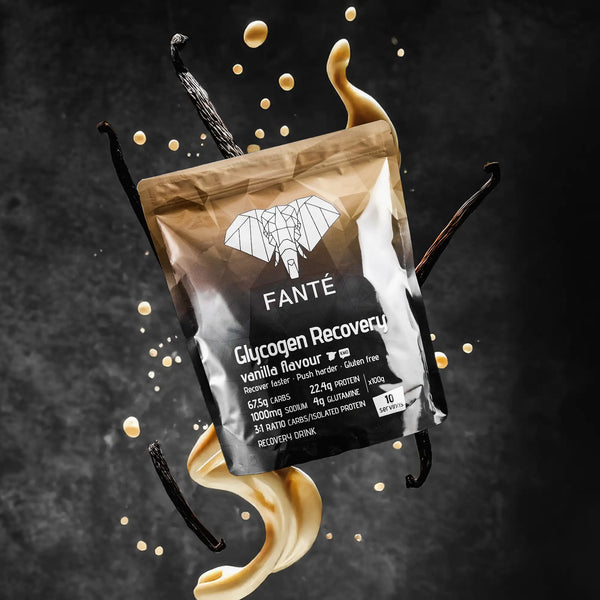
That's why we created GLYCOGEN RECOVERY DRINK.
Literature
- Thomas DT, Erdman KA, Burke LM (2016) American College of Sports Medicine Joint Position Statement. Nutrition and Athletic Performance. Med Sci Sports Exerc48, 543-568
- Wallis GA, Hulston CJ, Mann CHet al.(2008) Postexercise muscle glycogen synthesis with combined glucose and fructose ingestion. Med Sci Sports Exerc40, 1789-1794.
- Blom PC, Hostmark AT, Vaage O, Kardel KR, Maehlum S. Effect of different post-exercise sugar diets on the rate of muscle glycogen synthesis. Med Sci Sports Exerc . 1987;19(5):491-6.
- Van Den Bergh AJ, Houtman S, Heerschap A, et al. Muscle glycogen recovery after exercise during glucose and fructose intake monitored by 13 C-NMR. J Appl Physiol . 1996;81(4):1495-500.
- Shi X, Schedl HP, Summers RM, et al. Fructose transport mechanisms in humans. Gastroenterology . 1997;113(4):1171-9.
- Shi X, Summers RW, Schedl HP, Flanagan SW, Chang R, Gisolfi CV. Effects of carbohydrate type and concentration and solution osmolality on water absorption. Med Sci Sports Exerc . 1995;27(12):1607-15
- Jeukendrup AE. Carbohydrate intake during exercise and performance. Nutrition . 2004;20(7-8):669-77.
- Décombaz J, Jentjens R, Ith Met al.(2011) Fructose and galactose enhance postexercise human liver glycogen synthesis. Med Sci Sports Exerc43, 1964-1971.
- Fuchs CJ, Gonzalez JT, Beelen Met al.(2016) Sucrose ingestion after exhaustive exercise accelerates liver, but not muscle glycogen repletion compared with glucose ingestion in trained athletes. J Appl Physiol (1985)120, 1328-1334.
- Maunder E, Podlogar T, Wallis GA (2018) Postexercise Fructose-Maltodextrin Ingestion Enhances Subsequent Endurance Capacity. Med Sci Sports Exerc50, 1039-1045.
- Gonzalez JT, Fuchs CJ, Betts JAet al.(2016) Liver glycogen metabolism during and after prolonged endurance-type exercise. Am J Physiol Endocrinol Metab311, E543-553.