Fatigue during prolonged strenuous exercise is associated with glycogen depletion in active skeletal muscles, and muscle glycogen restoration is an important component in the recovery of exercise capacity (1) . Glucose intake immediately and at regular intervals after exercise increases the availability of glycogen substrates (i.e., glucose) and optimizes exercise- and insulin-induced stimulation of muscle glucose utilization, facilitating rapid short-term (<8 h) muscle glycogen storage (2) .
Total energy delivery can be enhanced when consuming beverages containing glucose and free fructose compared to carbohydrate solutions containing only glucose. For example, Shi et al. (3,4) demonstrated greater total intestinal carbohydrate absorption at rest when glucose and fructose were ingested simultaneously compared to glucose alone. Furthermore, we (5 , 6 , 7) and others (8) reported improved oxidation and peak delivery of ingested carbohydrates during exercise with combined glucose and fructose intake compared to an equivalent amount of glucose alone. The greater carbohydrate delivery observed at rest and during exercise is attributed to increased total intestinal carbohydrate absorption through the stimulation of multiple distinct intestinal transporters (glucose and fructose absorption being facilitated by sodium-dependent glucose transporter 1 [SGLT1] and glucose transporter 5 [GLUT5], respectively), leading to greater systemic availability of ingested carbohydrates (9).
The liver plays a crucial role in preventing hypoglycemia during exercise (10) , and strategies that improve hepatic glycogen after exercise are generally believed to increase exercise capacity in a subsequent exercise session (11) . Most studies have investigated the role of muscle glycogen after exercise (reviewed in Beelen et al. (12) and Jentjens and Jeukendrup (13)) , but very few studies have focused on the potentially very important role of substrates in the liver.
There is already evidence that small amounts of fructose stimulate glucokinase and glycogen synthase in the liver, the two rate-limiting enzymes of glycogen synthesis in the liver (14). Combinations of multiple transportable carbohydrates (i.e., glucose and fructose) have also been shown to result in higher rates of exogenous carbohydrate oxidation during exercise (15 , 16 , 17), suggesting better carbohydrate uptake than with a similar amount of glucose alone. Very high rates of exogenous carbohydrate oxidation have been reported for a mixture of maltodextrin and fructose (17) . Wallis et al. (18) suggested that this faster delivery of carbohydrates might also aid muscle glycogen synthesis after exercise.
[[CTA_COMMUNITY]]
IS IT POSSIBLE TO USE THE MILK WITH THE RECOVERY?
Another carbohydrate that could be beneficial for hepatic glycogen synthesis is galactose. The liver is the primary site of galactose uptake and metabolism in humans. In the liver, galactose can be converted to glucose and subsequently stored as glycogen or released immediately into the bloodstream.
In rats, glycogen formation accounts for the vast majority of galactose absorbed by the liver (18) . Consequently, a study using isolated perfused rat liver (19) demonstrated that galactose stimulated hepatic glycogen synthesis in the presence of glucose, with a concomitant increase in glycogen synthase activity and a decrease in glycogen phosphorylase activity. However, animal and in vitro studies (20 , 21) have shown that galactose ingestion results in lower rates of hepatic glycogen synthesis compared to glucose administration.
Therefore, combinations of glucose with fructose or galactose could be attractive when the goal is to amplify hepatic glycogen resynthesis in humans after glycogen-depleting exercise. To our knowledge, this has not been done before. However, energy-dense glucose solutions are hypertonic and can interfere with gastrointestinal (GI) fluid delivery. Maltodextrin (MD), a glucose polymer, tastes less sweet than glucose and has a lower osmolality. Because of this, the gastric emptying (22) and metabolic availability (23,24) of maltodextrin drinks are faster than those of glucose-based recovery drinks.
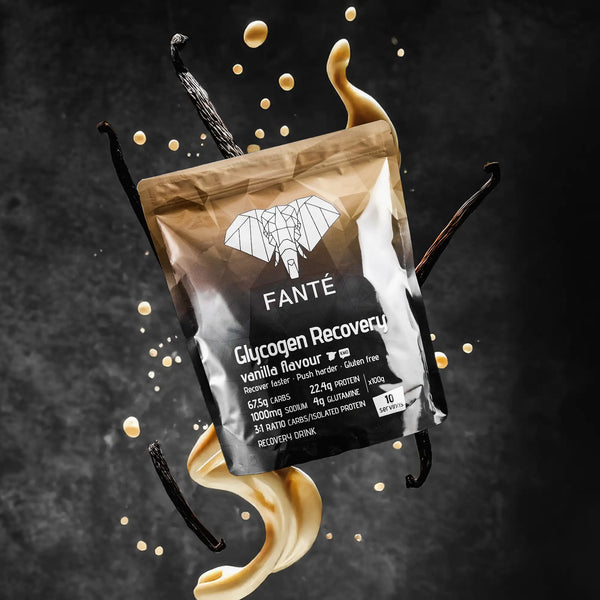
From FANTÉ, and together with our unique market usage methods already explained in detail in this guide , we give you the option of consuming it with milk or water depending on palatability and for a possible improvement in glycogen resynthesis.
In conclusion
It is recommended to ingest a mixture of glucose and fructose that provides an optimal dose of carbohydrates for the effective restoration of liver and muscle glycogen, thus reducing gastrointestinal discomfort caused by high carbohydrate intake (Alghannam et al., 2018) (25) . This is evident when considering that the use of sucrose (a disaccharide consisting of an equal amount (1:1) of glucose and fructose) appears to be more effective than consuming glucose alone (1:0), in addition to the fact, as mentioned above, that gastrointestinal discomfort does not occur when consuming glucose alone (Fuchs et al., 2016; Maunder, Podlogar, & Wallis, 2017) (26). Furthermore, a recent study has shown that when recovery needs to be immediate, mixing glucose and fructose (or sucrose) at a rate of ≥1.2 g/kg/hour (the recommended rate for recovery; for more information, see our glycogen guide) can improve glycogen replenishment rates while minimizing gastrointestinal discomfort (Gonzalez, Fuchs, Betts, & van Loon, 2017) (27). Ingesting liquid or solid forms of carbohydrates appears to be equally effective in restoring muscle glycogen, so the athlete's individual preference should take precedence (Keizer, Kuipers, van Kranenburg, & Geurten, 1987) (28). However, as Ranchordas (2017) (29) points out, from a practical perspective, given the high prevalence of gastrointestinal problems due to the consumption of high amounts of carbohydrates, it would be beneficial for athletes to have access to a variety of solid and liquid foods to help prevent these issues. Furthermore, it is important to consider the athlete's preferences (taste), practicality (e.g., two training sessions per day), availability (e.g., travel after competition, stadium/sporting events), and, importantly, to ensure that the foods stimulate the athlete's appetite so that they can meet their nutritional needs, as there may be a marked decrease in appetite after sporting events.
And with all this, at FANTÉ we created the best recovery drink on the market based on current scientific evidence. glycogen recovery drink
[[PRODUCT:glycogen-recovery-drink]]
Literature
- Bergstrom J, Hermansen L, Hultman E, Saltin B. Diet, muscle glycogen and physical performance. Acta Physiol Scand . 1967;71(2):140-50 .
- Ivy JL. Glycogen resynthesis after exercise: effect of carbohydrate intake. Int J Sports Med . 1998;19(Suppl 2):S142-5.
- Shi X, Schedl HP, Summers RM, et al. Fructose transport mechanisms in humans. Gastroenterology . 1997;113(4):1171-9.
- Shi X, Summers RW, Schedl HP, Flanagan SW, Chang R, Gisolfi CV. Effects of carbohydrate type and concentration and solution osmolality on water absorption. Med Sci Sports Exerc . 1995;27(12):1607-15.
- Jentjens RL, Achten J, Jeukendrup AE. High oxidation rates from combined carbohydrates ingested during exercise. Med Sci Sports Exerc . 2004;36(9):1551-8.
- Jentjens RL, Underwood K, Achten J, Currell K, Mann CH, Jeukendrup AE. Exogenous carbohydrate oxidation rates are elevated after combined ingestion of glucose and fructose during exercise in the heat. J Appl Physiol . 2006;100(3):807-16.
- Jeukendrup AE, Moseley L, Mainwaring GI, Samuels S, Perry S, Mann CH. Exogenous carbohydrate oxidation during ultraendurance exercise. J Appl Physiol . 2006;100(4):1134-41.
- Adopo E, Peronnet F, Massicotte D, Brisson GR, Hillaire-Marcel C. Respective oxidation of exogenous glucose and fructose given in the same drink during exercise. J Appl Physiol . 1994;76(3):1014-9.
- Jeukendrup AE. Carbohydrate intake during exercise and performance. Nutrition . 2004;20(7-8):669-77.
- Nilsson LH, Hultman E. Liver and muscle glycogen in man after glucose and fructose infusion. Scand J Clin Lab Invest . 1974;33(1):5-10.
- Casey A, Mann R, Banister K, et al. Effect of carbohydrate ingestion on glycogen resynthesis in human liver and skeletal muscle, measured by 13 C MRS. Am J Physiol Endocrinol Metab . 2000;278(1):E65-75 .
- Beelen M, Burke LM, Gibala MJ, van Loon LJ. Nutritional strategies to promote postexercise recovery. Int J Sport Nutr Exerc Metab . 2010;20(6):515-32.
- Jentjens R, Jeukendrup A. Determinants of post-exercise glycogen synthesis during short-term recovery. SportsMed . 2003;33(2):117-44
- McGuinness OP, Cherrington AD. Effects of fructose on hepatic glucose metabolism. Curr Opin Clin Nutr Metab Care . 2003;6(4):441-8.
- Jentjens RL, Jeukendrup AE. High rates of exogenous carbohydrate oxidation from a mixture of glucose and fructose ingested during prolonged cycling exercise. Br J Nutr. 2005;93(4):485-92.
- Jentjens RL, Moseley L, Waring RH, Harding LK, Jeukendrup AE. Oxidation of combined ingestion of glucose and fructose during exercise. J Appl Physiol. 2004;96(4):1277-84.
- Wallis GA, Rowlands DS, Shaw C, Jentjens RL, Jeukendrup AE. Oxidation of combined ingestion of maltodextrins and fructose during exercise. Med Sci Sports Exerc . 2005;37(3):426-32.
- Jeukendrup AE. Carbohydrate and exercise performance: the role of multiple transportable carbohydrates. Curr Opin Clin Nutr Metab Care . 2010;13(4):452-7.
- Wallis GA, Hulston CJ, Mann CH, Roper HP, Tipton KD, Jeukendrup AE. Postexercise muscle glycogen synthesis with combined glucose and fructose ingestion. Med Sci Sports Exerc . 2008;40(10):1789-94.
- Niewoehner CB, Neil B, Martin T. Hepatic uptake and metabolism of oral galactose in adult fasted rats. Am J Physiol . 1990;259(6 pt 1):E804-13.
- Sparks JW, Lynch A, Glinsmann WH. Regulation of rat liver glycogen synthesis and activities of glycogen cycle enzymes by glucose and galactose. Metabolism . 1976;25(1):47-55.
- Niewoehner CB, Neil B. Mechanism of delayed hepatic glycogen synthesis after an oral galactose load vs. an oral glucose load in adult rats. Am J Physiol . 1992;263(1 pt 1):E42-9.
- Williams CA. Metabolism of lactose and galactose in man. Prog Biochem Pharmacol . 1986;21:219-47.
- Sole CC, Noakes TD. Faster gastric emptying for glucose-polymer and fructose solutions than for glucose in humans. Eur J Appl Physiol Occup Physiol . 1989;58(6):605-12.
- Rowlands DS, Wallis GA, Shaw C, Jentjens RL, Jeukendrup AE. Glucose polymer molecular weight does not affect exogenous carbohydrate oxidation. Med Sci Sports Exerc . 2005;37(9):1510-6.
- Wallis GA, Rowlands DS, Shaw C, Jentjens RL, Jeukendrup AE. Oxidation of combined ingestion of maltodextrins and fructose during exercise. Med Sci Sports Exerc . 2005;37(3):426-32 .
- Alghannam, A., Gonzalez, J., & Betts, J. (2018). Restoration of Muscle Glycogen and Functional Capacity: Role of Post-Exercise Carbohydrate and Protein Co-Ingestion. Nutrients, 10(2), 253. https://doi.org/10.3390/nu10020253
- Fuchs, CJ, Gonzalez, JT, Beelen, M., Cermak, NM, Smith, FE, Thelwall, PE, … van Loon, LJC (2016). Sucrose ingestion after exhaustive exercise accelerates liver, but not muscle glycogen repletion compared with glucose ingestion in trained athletes. Journal of Applied Physiology, 120(11), 1328–1334. https://doi.org/10.1152/japplphysiol.01023.2015
- Gonzalez, JT, Fuchs, CJ, Betts, JA, & van Loon, LJC (2017). Glucose plus fructose ingestion for post-exercise recovery—greater than the sum of its parts? Nutrients. https://doi.org/10.3390/nu9040344
- Keizer, H.A., Kuipers, H., van Kranenburg, G., & Geurten, P. (1987). Influence of liquid and solid meals on muscle glycogen resynthesis, plasma fuel hormone response, and maximal physical working capacity. International Journal of Sports Medicine, 8(2), 99–104.https://doi.org/10.1055/s-2008-1025649
- Ranchordas, M.K., Dawson, J.T., & Russell, M. (2017). Practical nutritional recovery strategies for elite soccer players when limited time separates repeated matches. Journal of the International Society of Sports Nutrition. https://doi.org/10.1186/s12970-017-0193-89 .