
In high-performance sports, small details make a big difference. Among the most studied and effective nutritional strategies is the use of sodium bicarbonate in sports, a nutritional tool capable of improving exercise tolerance, delaying fatigue, and optimizing performance in high-intensity training and competitions. It is available at the Fanté sports nutrition store .
Its use, although supported by scientific evidence, requires precision: appropriate doses, correct intake times, and proper individual adaptation are essential to obtain its benefits without side effects.
[[CTA_COMMUNITY]]
Why is baking soda useful for improving athletic performance?
Sodium bicarbonate is the best pre-workout supplement for cycling . It acts as a buffer, helping to maintain pH balance in the blood and muscles during exercise. During high-intensity efforts, the body accumulates hydrogen ions (H⁺) and lactic acid, leading to a decrease in pH and, consequently, muscle fatigue.
The role of sodium bicarbonate in the control of lactic acid
When ingested, bicarbonate increases extracellular buffering capacity, helping to neutralize excess acidity produced during intense exercise. This allows for more efficient muscle contraction and delays the onset of fatigue, especially in endurance sports or threshold efforts.
How baking soda helps reduce muscle fatigue
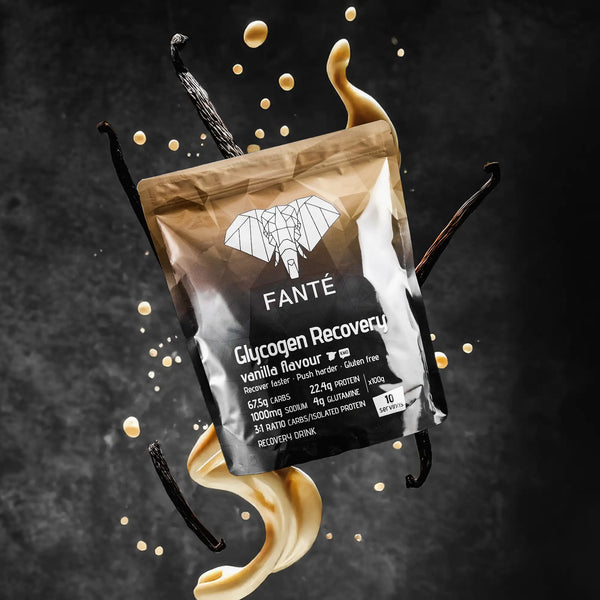
One of the main advantages of sodium bicarbonate in sports is its ability to support muscle performance for longer periods. By reducing metabolic acidosis, it preserves neuromuscular function and improves the ability to maintain high power output or sustained pace during prolonged efforts, such as cycling, running, or triathlon. It's also important to note that muscle recovery can be optimized by combining FANTÉ Buffer with any FANTÉ GLYCOGEN product .
[[PRODUCT:glycogen-recovery-drink]]
What does science say about the benefits of sodium bicarbonate in sports?
Numerous studies have shown that sodium bicarbonate improves performance in high-intensity exercise and intermittent efforts. Recent meta-analyses confirm that its supplementation can improve performance between 2% and 8%, depending on the type of sport and the athlete's training level.
How to safely take sodium bicarbonate for sports?
Bicarbonate is effective, but it also requires a controlled protocol. Unplanned use can cause gastrointestinal discomfort, so individualization is key.
Recommended dose of sodium bicarbonate for athletes
Scientific evidence recommends doses between 0.2 and 0.3 g of bicarbonate per kilogram of body weight, ingested 60 to 120 minutes before exercise. Beginner athletes can start with lower doses (0.15 g/kg) and gradually increase them according to individual tolerance.
Adaptation of sodium bicarbonate intake according to the sport discipline
In endurance sports and high-intensity interval training, the most effective strategy is to use chronic or staggered supplementation over several days prior to competition, rather than a single dose. This allows for a cumulative buffering effect and minimizes digestive discomfort.
Benefits of sodium bicarbonate in sports: how does it affect performance and recovery?
Improves endurance capacity during long runs
Bicarbonate of soda allows you to maintain a higher intensity of effort, reducing the burning sensation in your muscles and prolonging the time until fatigue sets in. This is especially useful in marathons, triathlons, and long-distance cycling events.
Reduces recovery time between intense workouts
By controlling metabolic acidosis, it promotes a faster recovery of muscle pH and electrolyte balance, allowing training with less residual fatigue.
You might be interested in → Why an electrolyte imbalance can be your worst enemy in a race?
Key effects of sodium bicarbonate on endurance athletes
The main physiological effects include:
- Increased time until exhaustion.
- Improved metabolic efficiency.
- Reduction of cramps and muscle burning sensation.
- Greater tolerance to lactate.
Fanté BUFFER: Carbohydrates and sodium bicarbonate for your best performance
FANTÉ BUFFER is a protocol designed to maximize the benefits of sodium bicarbonate in sports, combining 5g of bicarbonate per dose with fast-absorbing carbohydrates. This synergy reduces gastrointestinal discomfort and optimizes absorption, providing a sustained buffering effect and an efficient energy source.
Its formula has been developed for athletes seeking to improve their performance in threshold training, sprints or long series, guaranteeing digestive stability and measurable results in the perception of effort and performance, in addition, it improves recovery in endurance sports.
[[PRODUCT:fante-buffer]]
Frequently Asked Questions
What are the benefits of sodium bicarbonate in sports?
It improves the capacity for exertion, delays muscle fatigue, and optimizes recovery between intense workouts.
How should I take sodium bicarbonate before running a marathon or doing a long workout?
It is recommended to take it between 60 and 120 minutes before exertion, adjusting the dose according to body weight and individual tolerance.
Is it safe to take sodium bicarbonate during sports, and are there any contraindications?
Yes, provided the recommended doses are respected. People with kidney disease, high blood pressure, or gastric problems should consult a healthcare professional beforehand.
What dose of sodium bicarbonate should I use to improve athletic performance?
Between 0.2 and 0.3 g/kg of body weight, although lower doses can be started in athletes who are not used to it.
Does baking soda help cyclists improve their performance in long races?
Yes. In cycling, its use has been shown to improve the ability to maintain high power outputs and delay the onset of muscle fatigue, especially during threshold efforts.
Literature
1. Carr, AJ, Slater, GJ, Gore, CJ, Dawson, B., & Burke, L.M. (2011). Effect of sodium bicarbonate on [H+] regulation, buffering capacity and exercise performance. Sports Medicine, 41(10), 801–819.
2. McNaughton, L.R., Siegler, J., & Midgley, A. (2008). Sodium bicarbonate ingestion and exercise performance: An update. Sports Medicine, 38(7), 505–525.
3. Saunders, B., et al. (2016). A systematic review of sodium bicarbonate use in high-intensity exercise. Sports Medicine, 46(10), 1447–1466.
4. Peart, DJ, Siegler, JC, & Vince, RV (2012). Practical recommendations for coaches and athletes: A meta-analysis of sodium bicarbonate use for exercise performance. Journal of Strength and Conditioning Research, 26(7), 1975–1983.
5. Christensen, P.M., Petersen, M.H., Friis, S.N., & Bangsbo, J. (2014). Effects of bicarbonate ingestion on repeated high-intensity cycling performance in trained athletes. European Journal of Applied Physiology, 114(5), 967–979.
6. Burke, L.M., & Hawley, J.A. (2018). Swifter, higher, stronger: What's on the menu? Science, 362(6416), 781–787.